
DriveSavers: Raising Data from the Dead—Literally
As Halloween comes around every October, most people think of trick-or-treaters, zombies, and witches. But at DriveSavers Data Recovery, Halloween comes to mind nearly every day. We specialize in “raising data from the dead.” In this case, “the dead” is data from physically damaged or mechanically challenged computer hard drives, tablets, phones, and other types of devices.
DriveSavers is regularly called upon to recover information for law enforcement and court cases; anything from divorces to murder investigations. While these types of jobs are intriguing, they sometimes come with a level of stomach-churning reality and gruesomeness commonly found in the goriest Halloween horror films.
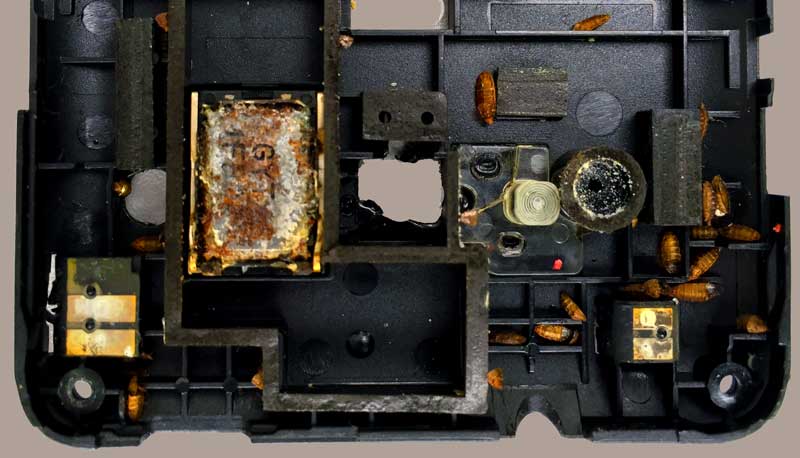
One year, a law enforcement agency contacted DriveSavers for help retrieving evidence from a cell phone that had been found on a bloody corpse at the scene of a murder investigation. The lens of the camera, which was built into the phone, had been pried off and completely removed, apparently in an effort to make the capture of photos and videos impossible (nice try!).
The computer crimes division at the law-enforcement agency had no luck retrieving any data, so they turned to DriveSavers for their advanced capabilities. The phone arrived in a plastic bag marked “evidence.” Upon disassembly, some bonus material was discovered. After crawling inside the device through the opening where the camera lens once was, a number of maggots had made it their home. Having been there for some time, they had advanced to the pupal stage where they resembled grains of brown rice. The larvae gave up no data, but the phone’s electronic storage chips did, allowing the suspects to be arrested and eventually tried for murder.
Another unique scenario prompted DriveSavers Cleanroom Engineer, Jon to exclaim, “Nobody wants to die at work!” In this situation, thirty hard drives were shipped from a Texas research facility where a drain pipe had burst. The flooded water was contaminated with the leptospirosis bacteria, common in water where rodents have expired. Because the drives had been subjected to water damage or other potential contaminants, they had to be specially treated. DriveSavers has developed a strict protocol to handle biohazards by first decontaminating them before they are handled. DriveSavers data recovery engineers were fully suited up in biohazard attire identical to what was used by international health workers during the 2014 Ebola outbreak.
Working with a partner in 2011, DriveSavers helped many businesses and individuals in Japan following the earthquake, tsunami, and subsequent Fukushima reactor meltdown. Many of the drives that arrived were wet, physically damaged and some even had sand inside their mechanisms. While these types of symptoms were enough of a challenge to overcome, the team at DriveSavers had to take extra precautions. This time the biohazard gear would do little to protect us. Instead, we had to rely on a Geiger counter to test all arriving devices for radioactivity. Fortunately, none of the readings taken were above the typical background radiation found in our environment.
Whether data is lost or has become inaccessible due to physical damage, device failure, or intentional destruction—data loss can be frightening. To avoid the nightmare of lost data, we remind you to always back up your critical files. We recommend triple redundancy—backing up to at least two different locations in addition to your working copy, such as an external backup drive and the cloud.

 English (United States)
  English (Australia)
  French (France)
  English (UK)
  French (Canada)
  English (Canada)
  Spanish (Mexico)
  German
  Dutch
Dutch  Italian
  Finnish
  Polish
  Norwegian
  Swedish
  Danish
  Spanish (Spain)
  Chinese
  Japanese
  German (Austria)